
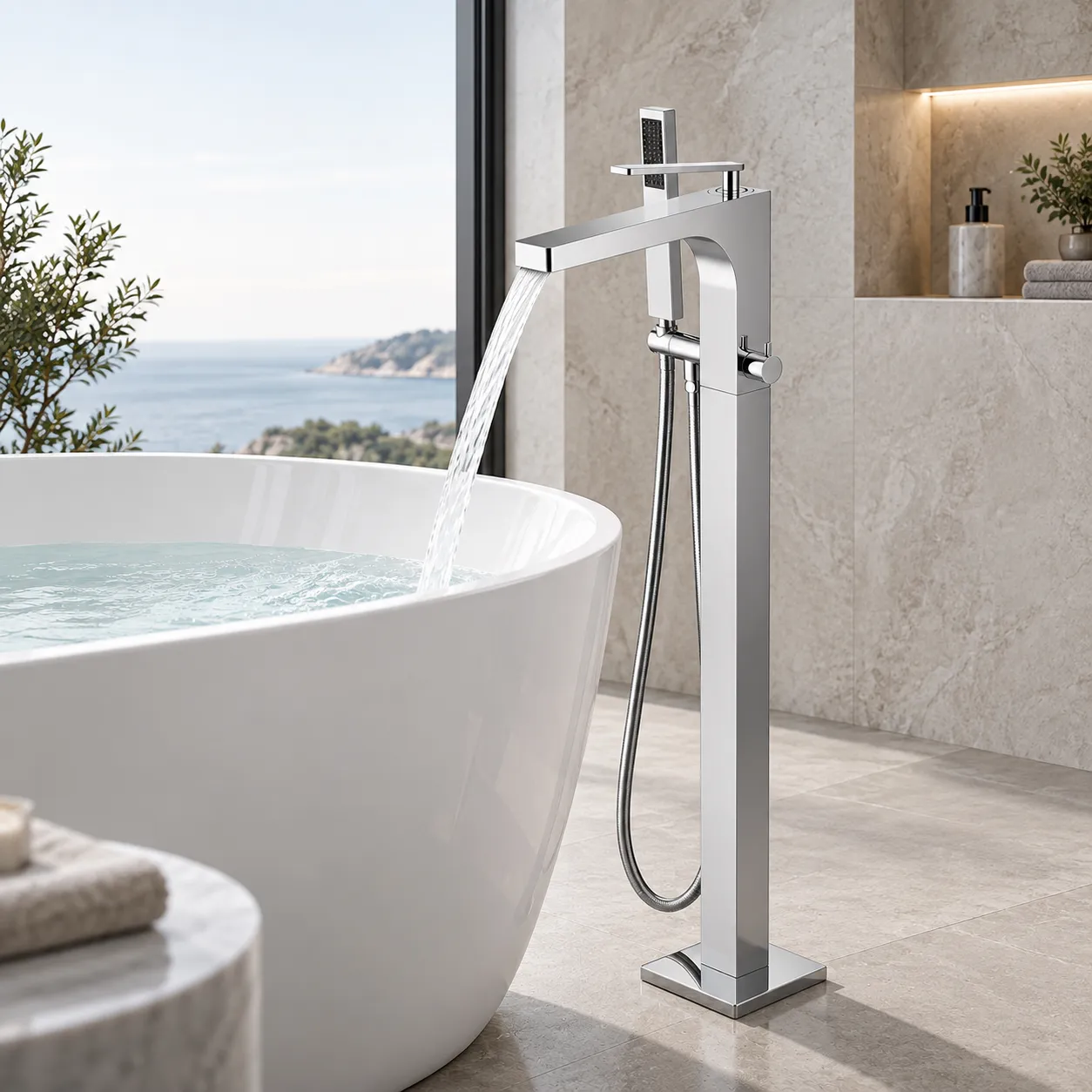
A freestanding bathtub is often the centerpiece of a modern bathroom. While the appearance of a freestanding tub filler plays an important role in product selection, its performance and installation requirements deserve equal attention.
For bathroom brands, importers, and product development teams, selecting the right freestanding tub filler involves more than choosing a design and finish. Flow rate, operating pressure, internal construction, installation compatibility, and certification requirements can all influence the suitability of a product for a particular market.
This guide explores the key factors to consider when evaluating a high-flow freestanding tub filler for a bathroom product collection.
1. Understand Why Flow Rate Matters
Flow rate describes the volume of water delivered by a faucet over a given period, typically expressed in gallons per minute (GPM) or liters per minute (L/min).
For bathtub applications, flow rate is particularly relevant because bathtubs generally require substantially more water than washbasins.
A higher flow rate can reduce the time required to fill a bathtub, provided that the plumbing system can supply sufficient water.
For example, consider a bathtub requiring approximately 60 gallons of water:
| Flow Rate | Theoretical Filling Time |
|---|---|
| 5 GPM | 12 minutes |
| 8 GPM | 7.5 minutes |
| 12 GPM | 5 minutes |
| 16 GPM | 3.75 minutes |
These figures are theoretical calculations based on constant flow. Actual filling times depend on water pressure, supply pipe capacity, system restrictions, and the required filling volume.
When comparing tub fillers, buyers should always check the water pressure at which the stated flow rate was measured. A faucet rated at 16 GPM under one test condition should not automatically be expected to deliver the same flow rate in every installation.
2. Evaluate the Internal Waterway Design
The external dimensions of a freestanding tub filler do not necessarily indicate its flow capacity.
Two faucets with similar appearances may perform differently because of variations in their internal waterway design.
Important considerations include:
- Internal passage dimensions and potential flow restrictions
- Cartridge and valve configuration
- Water inlet connections
- Spout construction
- Compatibility with the intended water supply system
For high-flow bathtub applications, the complete waterway should be evaluated rather than relying on a single component specification.
3. Compare Installation Methods
Installation compatibility is another important consideration when developing a freestanding tub filler collection. Different projects may require different floor-mounting solutions.
Tripod Mounting Systems
A tripod-style mounting system uses a supporting structure to secure the freestanding faucet to the floor.
Depending on the product design, this approach may offer a practical installation solution for certain project requirements. However, compatibility depends on the faucet construction, floor conditions, and installation instructions.
Rough-in Box Systems
A rough-in box is installed as part of the plumbing preparation before the finished faucet is mounted.
This approach can help coordinate the positioning of the faucet and water connections during construction.
For brands serving residential developments, renovation projects, or professional installation markets, the availability of a suitable rough-in solution can be an important product-selection factor.
Neither installation method is universally better. The correct choice depends on the specific faucet model and the intended application.
4. Consider Material Selection and Construction
Brass and stainless steel are commonly used in faucet manufacturing, but the suitability of each material depends on its grade, construction, operating environment, and applicable market requirements.
Brass Construction
Brass is widely used in plumbing fixtures because of its machinability and established manufacturing applications.
When evaluating brass faucets, buyers should consider the material specification, internal construction, surface treatment, and drinking-water-contact requirements where applicable.
304 Stainless Steel Construction
304 stainless steel offers corrosion resistance in many typical bathroom environments and provides an alternative material option for selected faucet designs.
However, material selection alone does not determine product durability or regulatory compliance. The overall product design, components, finishing process, and installation environment remain important.
For OEM and private-label projects, brands should request accurate material specifications for the exact model being evaluated.
5. Review Finish Options and Product Consistency
A freestanding tub filler is often paired with basin faucets, shower systems, and bathroom accessories.
For this reason, finish coordination is important when building a complete bathroom collection.
Common finish options include:
- Polished Chrome
- Brushed Nickel
- Matte Black
- Brushed Gold
- Brushed Rose Gold
- Gunmetal
Beyond visual appearance, buyers should evaluate finish consistency across different product categories.
Surface preparation, finishing methods, inspection standards, and production controls can influence the final appearance and durability of a finish.
For private-label collections, reviewing physical finish samples is a practical step before confirming production.
6. Verify Certification Requirements for the Target Market
Different markets may have different requirements for plumbing products.
For example, buyers supplying North America may need to evaluate applicable plumbing product certifications and local regulatory requirements. Australian and New Zealand markets may have different certification and material requirements.
Certification should always be checked at the individual model level. A manufacturer’s general certification status does not automatically mean that every faucet in its catalog is covered.
Before finalizing a product selection, buyers should verify the relevant certificate, listed model numbers, applicable standards, and any market-specific conditions.
7. Match the Tub Filler to the Product Collection
The best freestanding tub filler is not necessarily the model with the highest advertised flow rate.
For bathroom brands and importers, the selection should balance several factors:
- Suitable flow performance for the intended bathtub application
- Installation compatibility
- Reliable internal components and construction
- Consistent finishes across the product range
- Appropriate documentation and certification
- Manufacturing repeatability for ongoing supply
A product that performs well in a showroom but is difficult to install or maintain may not be the most suitable choice for a long-term collection.
This is why technical evaluation should take place alongside design selection.
8. Exploring High-Flow Tub Filler Solutions with LandonBath
At LandonBath, freestanding tub fillers are one of our core product categories.
Our product range includes different designs, material configurations, finishes, and mounting solutions for bathroom brands and importers.
For example, our ARCO DF-02048 freestanding tub filler has a reported flow rate of 16.27 GPM at 60 psi under its specified test conditions.
This model can serve as a reference point for buyers evaluating higher-flow bathtub faucet options.
Actual project suitability should still be assessed against the intended water supply conditions, installation requirements, and applicable certification scope.
For OEM and private-label customers, product discussions can also include finish selection, installation configuration, packaging, and other technically feasible customization requirements.
Conclusion
Choosing a high-flow freestanding tub filler requires a balance of performance, construction, installation compatibility, appearance, and market requirements.
For bathroom brands developing a reliable product collection, comparing verified technical specifications is more valuable than selecting products based on appearance or headline flow-rate figures alone.
A well-planned selection process can help create a more consistent product range and support long-term supplier collaboration.
Looking for Freestanding Tub Filler Solutions?
Explore LandonBath’s freestanding tub filler range or discuss product specifications, installation options, finishes, and OEM/ODM requirements with our team.